
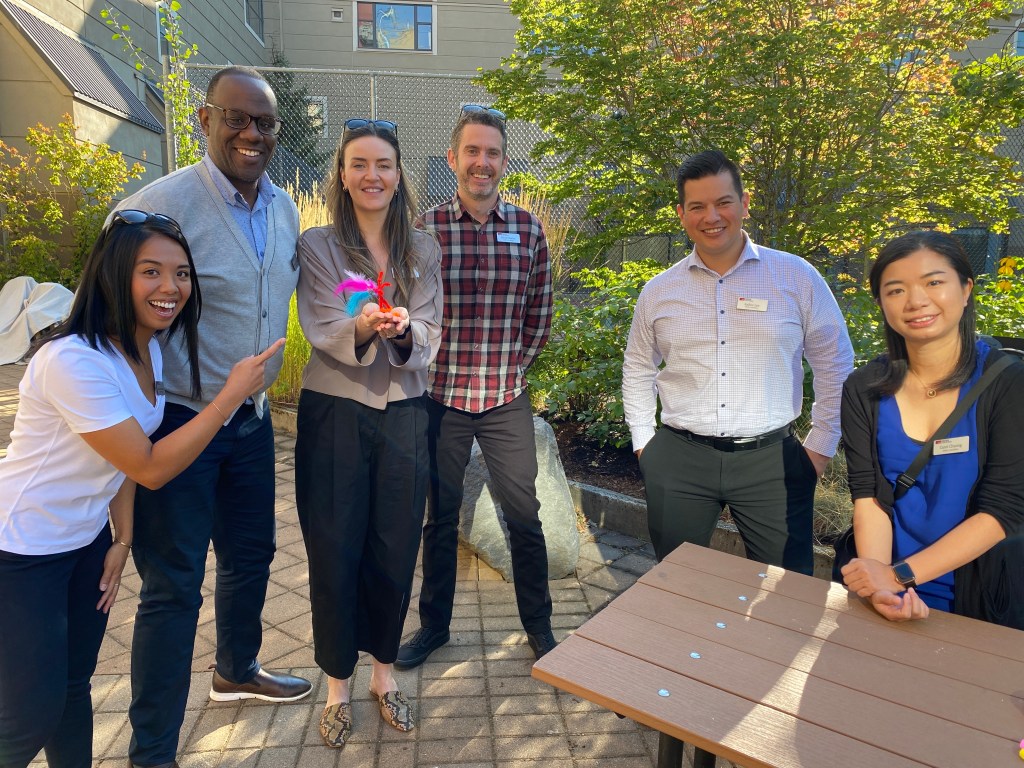
We launched the SFU EMBA program with a mandatory 3-day retreat in picturesque Whistler, BC.
It was a beautifully crafted weekend organized by our coordinator, Catherine Craig. Through a combination of structured discussion time, group activities, catered meals, and social opportunities, we were able to create meaningful connections with a majority of our cohort.
The Hilton Whistler in the heart of the village was our home for the weekend, with our individual rooms (including king-sized beds for starfishing), fully catered meals (no worrying about groceries and meal prep), and bright meeting rooms and outdoor courtyard for our sessions.
In the three-day period, I had so many a-ha! moments that I could already apply to my personal and work life, and this reinforced my excitement for the program.
Here are a few of my favourite takeaways:
‘Slow down to speed up’
Our Business Leadership professor, Dr. Jeff Yip, shared how this retreat weekend was designed to create connections in a paced way rather than jumping into the syllabuses and group work. Our slower pace in a setting away from home allowed us to build the relationship foundations that will enable us to launch into this program at full-speed in the following weeks.
This is also what we’re doing at The ScoliClinic. We’re approaching this coming year with a steady pace following the stress of the pandemic, our major clinic flood in April, and significant changes in staff (all we want is a normal, boring, uneventful year… is that so much to ask?!). I’m stepping back to focus on school and taking the gas off the growth pedal, so we can create clarity and strategy on where we want to go next.
Don’t get me wrong, this will be an intense year of learning for myself as I dedicate energy to learning our program content, and for my business partner Madison as she takes the reins of the company.
This mantra is also another way to re-frame the possible upcoming recession – slower market times can serve as an opportunity to direct our attention internally, so we’re ready to speed up when the timing is right. We approached the pandemic in a similar way; in that two-year period, we built an internal staff resource website, we fully digitized staff onboarding materials, launched a YouTube channel to improve accessibility, and more.
Structure Dictates Function
At the meta level, I observed how the retreat structure was designed to achieve the goal of creating connection. In my work, I teach short inservices, facilitate full-day workshops, and run team meetings, and I learned a lot from experiencing a well-run weekend.
There was an effective mix of sitting in lecture-style talks, standing conversations in the sunny courtyard, well-timed meals, walking activities after meals (to avoid the food coma!), small and large group discussions, and built-in free time for people to recharge or socialize. I tend to have a limited attention span but I was fully engaged all weekend!
On day 1, there were many short group discussions with only 2 or 3 people, and the discussion prompts helped us to get real deep, real fast. This push for vulnerability bypassed standard superficial networking conversations. A couple examples:
- There was pre-reading on ‘crucible moments‘ (the reading was the one from Harvard Business Review but since it’s behind a paywall, I linked a different article that also explains the concept) – situations in your life that really helped shape who you are. We met in small groups to share our crucible moment and learned that they could be ‘big E’ Experiences (major events like being fired, loss of loved one, etc) or ‘little e’ experiences (a comment made in passing, situation that may be insignificant to others but made a huge impact on you)
- We went for a forest walk in pairs, where we shared a future-oriented challenge that we’re facing. We practiced feedforward conversations that involved active listening, asking probing questions, and providing insight into our partners narrative
On day 2, we met our teams (see my stellar team in the photo) – our groups of 5 or 6 people with whom we’ll complete all our group projects with for the first year. It was clear that the faculty carefully chose our groups, as each team was diverse with regards to gender, age, ethnicity, and skill set.
We had more focused conversations, but our main group activity was the ‘Amazing Race’ (but actually we walked, to limit liabilities). So we [sped]walked through the village, finding stations and completing challenges together as a team; we were effective in the tasks, and came second overall!
Our biggest lesson during the activity: at one station, we launched into completing the task, missed a step and had to re-do it. Our second attempt was more carefully planned, and we nailed it! But, had we slowed down to create a plan at the start, we actually would have come in first place. It reinforced the weekend theme of slowing down to speed up.
Reflecting on the design of the weekend, it made me realize how important it is to be aware of the structures we put in place in our organizations. As a healthcare service, The ScoliClinic must be aware of how our clinics are laid out, how appointments are structured, how educational materials are delivered, how we teach workshops – do the structures we’ve implemented support or hinder the functions we’re aiming for?
Operate in Three Time Zones
Another session facilitated by Jeff highlighted how leaders must learn to simultaneously operate in three time zones: the past, the present, and the future.
Past: we must be willing to reflect on past experiences and learn from them; acknowledging the situation, the dynamics, and our position in our personal development at that point
Present: we must be willing to address ‘the elephant in the room’, be realistic with what’s happening now, and be decisive with what need to happen
Future: we must be willing to think about the future; how do I want to grow as a leader? Where do we want to go as an organization? What’s the legacy I want to leave?
Zooming out on the whole weekend, Jeff seamlessly integrated these timezones into our structured discussions, to help us practice thinking in each phase.
So what? Now what?
In an information-driven society where knowledge is readily available and comin’ in hot from all directions, Jeff encouraged us to ask ourselves ‘so what?’ to determine the relevance (or irrelevance) of new knowledge.
If information IS important, we must then ask ourselves ‘now what?’ to formulate concrete actions for integration.
I believe that mental and emotional agility is required in leadership. How do you know when it’s appropriate to slow down, or speed up? How can you plan an effective meeting, workshop, or service? How can you bounce between timezones when making decisions? How can you process the so-whats and the now-whats?
For me, integration has only been possible through a practice of self-reflection. I’ve been journalling for the past 7+ years, and there’s a noticeable difference in my ability to digest experiences when I have gaps in my practice because life happens fast. Putting pen to paper has served as a [sometimes uncomfortable] way to slow down, process my current struggles, look to the past for lessons learned, and use the future goals to inform the decisions I need to make today.
Fellow SFU EMBA students, past and present – what were your biggest takeaways from your Whistler experience?
-Andrea
Join me in the classroom of life!
 Andrea Gets Schooled
Leave a comment