
Together with my good friend and fellow clinic owner Anniken Chadwick of The Cheerful Pelvis, we shared our experiences of owning niche physiotherapy practices at the recent Annual BC Physio Forum, and highlighted implications of specialization on three main stakeholder groups: clients, clinicians, and clinic owners – now summarized into this three-part blog series.
With the theme of the conference being ‘Adapting To A Changing World’, we focused on an adaptation that we’re observing in many areas of healthcare: the rise of interest in niche practices.
Part 1 focused on the implications of specialty services for clients who seek these focused treatments.
Part 2 offered considerations for therapists who are considering, or already are, specializing in a specific area of Physiotherapy.
In this Part 3, we look at specialization from the lens of a clinic owner, exploring the situations for generalized practices who have a couple specialized therapists, versus owners who choose to open a practice fully dedicated to their niche.
*Re-iterating our disclaimer: we use the word ‘specialization’ throughout this series as a synonym for ‘niche practice’ or ‘focus area’ as it’s an appropriate descriptive word; however we are aware that there are very few niche areas allowed to be called official specializations by our College. In our businesses, we do not use this term.
When I started working with the scoliosis population, I thought that I was offering ‘specialized treatment’ by using custom equipment and a particular skillset. While I wasn’t wrong, the last seven years of growing a company has taught me that offering an impactful ‘specialized service’ to the world requires so.much.more.
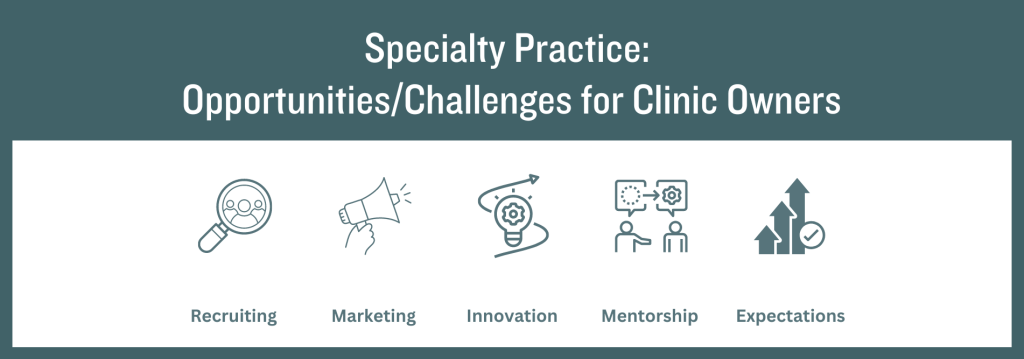
Although your niche’s needs must be accounted for in every corner of your business, we’re highlighting the five main areas where opportunities and challenges arise for clinic owners regarding specialized services.
Recruitment
In the current environment, it seems like every clinic is hiring. Due to an aging patient population with an increased awareness and value for physiotherapy, combined with a supply shortage of physiotherapists, the competition to recruit is fierce.
By nature of their specialization, niche clinics have an ability to set themselves apart from the noise. Anniken and I have both had therapists approach us with interest to work for our respective teams, even when we didn’t have any active job postings.
The flip side – the recruitment funnel narrows significantly because three important conditions need to be met in order to successfully hire a therapist:
- The therapist needs to be interested in specializing
- They need to be interested in your specific area
- They need to be a culture fit for your team
However, it seems that those who do want to join the team often have a personal connection or passion for that practice area, so the connection and values alignment may be strong. At The ScoliClinic, half of team has a personal or family connection to scoliosis and their passion shows up in many aspects of their work.
Additionally, since the pool of interested therapists is small, it’s much harder to find a therapist with experience in your niche area. This makes the onboarding runway much longer, as the responsibility falls on the clinic to ensure any new therapists are well-equipped with the specialized skills they require for that niche.
Marketing
Marketing is often simplified to represent advertising, however ‘marketing’ is actually an umbrella term that encompasses aspects such as branding, reputation, space atmosphere, service design, public communications, and advertising.
Because a concentrated demographic walks through a niche clinic’s doors, there’s a massive opportunity to do informal ‘market research’ by observing trends in clients’ needs and wants, frustrations, and wins. These values can be integrated into clinic communications in real time, and resultantly are more impactful as your messaging is more likely to resonate with your target population.
Note: marketing strategies may change; a niche clinic may become a destination clinic rather than a neighbourhood one. Therefore the geographical targets may be broader than a typical generalized clinic.
If you own a generalized clinic, it requires extra effort to create these focused messages to build the caseload of a specialized therapist on your staff.
More important note: if you’re a first mover in your niche, you’ll likely need to educate others about your service, and essentially convince healthcare professionals and the public that your service has value in society. Facing skepticism can be emotionally taxing, and therefore requires self-confidence and strong conviction in your offering in the early years.
Innovation
A beautiful aspect of owning a specialty business, or any business for that matter, is that you can do things your way. You can use the agility of small business to be responsive to your clients’ needs.
The tax of owning a niche clinic is the extra mental effort and critical thinking required to innovate. Anniken and I often chat about how to adapt general clinic ownership advice into each of our practices, as it doesn’t always work to copy-and-paste a given strategy.
Keep this in mind if you’re considering opening a niche clinic: are you a creative person? Do you like venturing into the unknown? What’s your mental (and financial) tolerance for trial and error… because that’s often what has to happen as you design, build, and iterate your services to truly suit the needs of your population.
Mentorship
Since many therapists join our teams at The Cheerful Pelvis and The ScoliClinic with minimal experience in pelvic health or scoliosis, onboarding and mentorship have become crucial parts of our practices.
The challenge: how do we package our experience and operationalize it, so that we can teach it to new staff in a digestible way?
As individuals who approach leadership in a mindful way, we’ve learned that we must balance the tension between honouring a therapist’s learning journey, while ensuring quality control for our clients.
Additionally, we must be aware of our instruction at the meta level; our beliefs, philosophies, approaches, language, biases all influence how we train our staff, which is a big responsibility.
We both realized that in a fully dedicated specialty practice, the growth of our practice is fully dependent on how fast and effectively we can train our staff, not how fast we can hire (in contrast to a general orthopaedic clinic) – and this can create a bottleneck. There’s no threshold to cross that designates a ‘good’ therapist, so efforts become more directional in nature (continual improvement in XYZ areas) instead of goal-oriented (receiving a certificate).
- Building an onboarding program requires intentionality in curriculum design, teaching strategies, communication and feedback channels, educational resource development – we’ve iterated ours more than 10 times over the years, and we still have a lot to learn.
- Developing an effective mentoring structure is even harder because it’s a moving target that changes shape depending on where each mentee and mentor are at individually, AND their relational dynamics. It requires combining data (booking metrics, chart notes, observed skills) with emotional awareness (what’s going on underneath that’s driving certain patterns?), and mentors need to actively work on their coaching skills too.
Carefully designed onboarding and mentoring programs are something that fully specialized clinics can offer, and that comes at a cost.
(Tip: Mentoring is a significant part of our payroll, which was an ‘unexpected cost’ when I first opened my company. If you’re thinking of opening a clinic, factor these wages into your forecast!)
On the flip side, an owner of a general practice may have the capacity to pay a premium wage to a therapist with a specialized skillset, but if the owner isn’t trained in that niche, it will be more challenging to support that therapist via mentorship AND it will be more difficult to monitor their output quality.
Expectations
If you run a fully specialized clinic, the expectations from peers and the public will be higher, and this creates a high level of pressure on owners. If a client has a bad experience, they may feel develop a narrative that ‘if the specialists can’t help me, it’s impossible to fix’.
Furthermore, there’s a sense of responsibility as a specialized clinic represents that particular niche to the public, as well as the physio profession as a whole. The hardest part: we’re setting the standards, and making it up as we go.
In conclusion, specializing your physiotherapy practice is much more than advertising a specific skillset. Whether you’re a clinician who specializes or a clinic owner, there are clear opportunities and consequences for yourself, your staff, and your clients.
In the Greater Vancouver area, we’re reaching a saturation of generalized physiotherapy clinics, so we anticipate that more therapists will choose to specialize their practices in the near future, which will dramatically change the landscape of physiotherapy services.
Let’s keep the conversation going! If you have questions about specializing or opening a specialty practice, reach out to Anniken and/or I below.

Learn more about Anniken’s work as a Pelvic Health clinic owner & coach:

Connect with me on socials, follow our team’s work, or reach out if you have specific questions:
Join me in the classroom of life!
 Andrea Gets Schooled
Leave a comment