
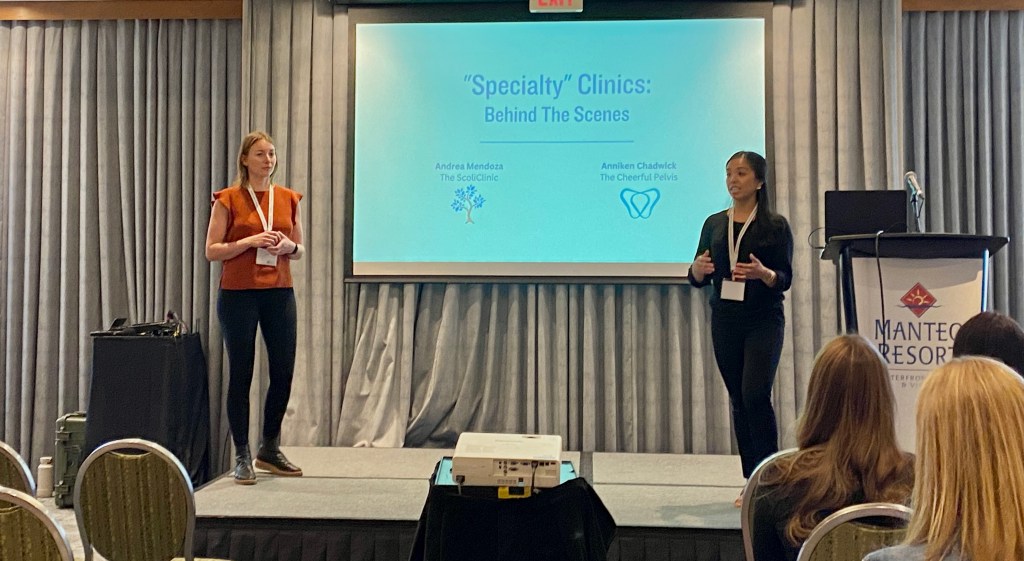
I had the honour of speaking at the Annual BC Physio Forum in Kelowna, BC with my good friend and fellow clinic owner Anniken Chadwick of The Cheerful Pelvis. Through our parallel journeys of owning niche physiotherapy practices, we highlighted implications of specialization on three main stakeholder groups: clients, clinicians, and clinic owners – now summarized into this three-part blog series.
The 2023 BC Physio Forum focused on how Physiotherapy is “Adapting To A Changing World”. Many adaptations are occurring in the rehab industry – telehealth for virtual treatments, short form digital content to satisfy shortening attention spans, online courses for knowledge sharing without the travel, and more. In this blog series, we focus on an adaptation that we’re observing in many areas of healthcare: the rise of interest in niche practices.
What are examples of niche practices? Whether it’s a single Physiotherapist in a general clinic with additional training, or a clinic that’s fully dedicated to a specific demographic, a ‘niche practice’ means that there is a higher-than-average level of attention on a specific body part, condition, or treatment method.
Examples of existing niche practices: pelvic health, concussion, shoulder issues, neck injuries, breast cancer rehab, paediatrics, ballet injuries, circus injuries, running optimization, scoliosis, Parkinson’s treatment; yoga therapy, clinical pilates, and SO MANY MORE.
And hyper-niches exist too: paediatric concussion, shoulder rehab for baseball players, yoga rehab for veterans, infantile scoliosis, and basically every combination of niches that you can think of.
The goal of presenting our session and publishing this content is to address myths about specialization, share opportunities and challenges of a highly focused practice based on our experiences, and spur conversation around this shift in the rehab industry as this will affect the healthcare industry as a whole.
*Disclaimer: we use the word ‘specialization’ throughout this series as a synonym for ‘niche practice’ or ‘focus area’ as it’s an appropriate descriptive word; however we are aware that there are very few niche areas allowed to be called official specializations by our College. In our businesses, we do not use this term.
What changes are driving this adaptation?
- Increasing volume and availability of clinical research and experience: therapists are able to learn endlessly about a specific group of conditions, thus gaining a depth of understanding rather than a broad overview; new treatment tips & tricks are constantly being shared on social media which contributes to the growing of skillsets to treat very specific areas
- Evolving client shopping behaviours: with the rise of google, social media, forums, and online reviews, clients are viewing healthcare as a consumer good. People are less likely to blindly follow a referral from a physician; instead, they hunt and appraise available options to find the best fit for their needs at that time in their life.
- Shifting career aspirations of younger generations: millennial and gen Z therapists are no longer satisfied with working in 1-2 jobs until retirement. Novelty, passion, ‘fit’, and differentiation are common values of the newer graduates (more on this in part 2).
Part 1: How niche services affect clients
Custom Spaces & Experiences
A fully dedicated practice allows clinics to design every aspect to suit their demographics needs. From clinic layout, ambience, in-clinic supplies, equipment for purchase, staff training – all are designed with a specific group in mind.
For example, having private treatment rooms with an easily accessible bathroom is necessary for clients seeking pelvic floor treatment; in contrast, scoliosis treatment often involves group sessions, so an open gym space with multiple bars for hanging exercises are beneficial. Front desk staff can be trained with processes and language around specific conditions that gathers relevant information in a meaningful way, to be less transactional.
Consistency
Niche clinics may offer some standardization of services and quality control of the care delivered across multiple therapists, which can offer a higher level of consistency for clients seeking treatment.
This may improve continuity of care over the long-term (for example, if a therapist leaves the company, clients can continue their care with another similarly trained team member) AND can solidify trust with fellow healthcare professionals who may refer to the company for a more predictable experience.
However, this does require formalized structures for onboarding, mentoring, client intake and assessment, which clinic owners may or may not focus on, so keep in mind that a dedicated practice does not necessarily guarantee consistency.
Availability
On a related note, niche practices may facilitate more timely access to treatment. A solo specialized therapist at a general practice may be booked for weeks, or even months. A clinic with multiple therapists would have more appointment options for a client’s preferred days and times (after-school hot spots anyone?).
Quality(?)
A client attending a niche clinic may assume, or expect, a higher quality of care. However, a higher quality isn’t guaranteed because there are very few specializations that have accreditations or official ways to indicate that a therapist is actually competent in that area of practice. Anyone can say they focus on an area of the body, or a specific group of conditions, and the profession has yet to design a way to assess proficiency for these niche areas.
Moreover, the jury is out: is it better to have three highly skilled physios treating three separate body parts, or a single more generalized physio who can put the bigger picture together?
Are you a therapist that works in a niche areas? What are some benefits/challenges that you see from the client’s perspective?
Stay tuned for Part 2: How ‘niching down’ affects clinicians.
– When’s the right time to specialize?
– What are the benefits of finding a niche?
– What challenge might arise?
If you’re a therapist thinking about focusing your practice or taking the leap into fully opening a specialized clinic, Part 2 is for you.

Learn more about Anniken’s work as a Pelvic Health clinic owner & coach:

Connect with me on socials and follow our team’s work:
Join me in the classroom of life!
 Andrea Gets Schooled
Leave a comment