
Together with my good friend and fellow clinic owner Anniken Chadwick of The Cheerful Pelvis, we shared our experiences of owning niche physiotherapy practices at the recent Annual BC Physio Forum, and highlighted implications of specialization on three main stakeholder groups: clients, clinicians, and clinic owners – now summarized into this three-part blog series.
With the theme of the conference being ‘Adapting To A Changing World’, we focused on an adaptation that we’re observing in many areas of healthcare: the rise of interest in niche practices.
Part 1 focused on the implications of specialty services for clients who seek these focused treatments.
In this Part 2, we dive into the considerations for therapists who are considering, or already are, specializing in a specific area of Physiotherapy.
*Re-iterating our disclaimer: we use the word ‘specialization’ throughout this series as a synonym for ‘niche practice’ or ‘focus area’ as it’s an appropriate descriptive word; however we are aware that there are very few niche areas allowed to be called official specializations by our College. In our businesses, we do not use this term.
Part 2: Considerations for niche clinicians
How might working with a niche population affect a therapist? If you’re a clinician thinking about diving deeper into a condition or a group, here’s some food for thought.
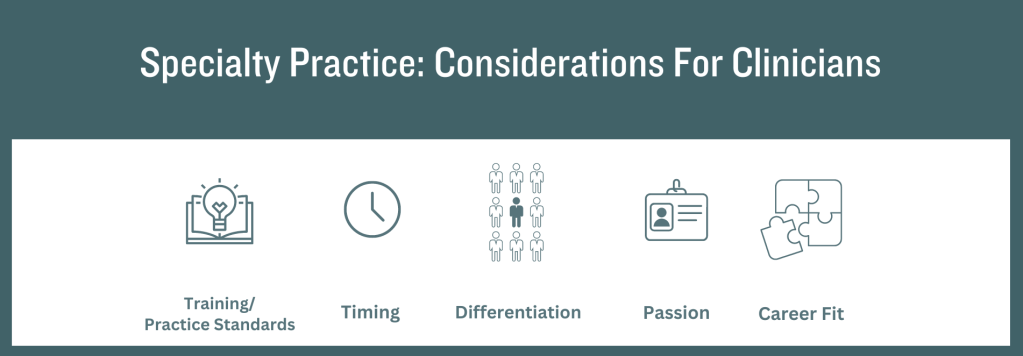
Training/Practice Standards
Very few niche areas have standardized training or widely-accepted certifications. For the courses that do exist, their availability, location, and frequency of offerings are often few and far between.
Most specialty areas do not have specific credentialing, so it can be a ‘wild west’ of best practice claims, sometimes with conflicting advice. As a practitioner, it’s necessary to research the courses, instructors, and the science on which these approaches are founded. If possible, we recommend speaking with already-trained therapists to inquire about the learning experience and overall usefulness of a course.
Timing
Is there a right time to specialize? Common advice recommends newer therapists to work in general practice for several years to learn a broader range of skills prior to specializing. The truth is, we don’t know.
From our experience, both Anniken and I have observed brand new graduates thrive in our respective niche areas of pelvic health or scoliosis; we’ve also seen new grads struggle to manage the steep clinical learning curve of a niche while navigating the transition to being a full-time Physiotherapist (caseload management, administrative tasks, time management, therapeutic relationship building, etc).
On the flip side, we have seen experienced physiotherapists bring that knowledge and clinical wisdom to elevate their work in the niche; and we’ve also had seasoned physiotherapists struggle to adapt to the unique ways of a specific population (shifting to manual treatment vs exercise prescription or vice versa, assessment processes, documentation procedures, differing pace of appointments, new style of treatment planning, etc).
Differentiation
In some markets like the Greater Vancouver area, there’s a saturation of generalized physiotherapists. By finding a focused practice area, a therapist can set themselves apart and develop and grow a unique personal brand.
The physiotherapy community is generally small, and a well-developed reputation for a particular skillset can spread like wildfire, thus helping a therapist grow their caseload, and potentially open doors to diverse work opportunities such as gaining social media sponsorships, monetizing a YouTube channel, running webinars and in-person teaching opportunities.
A therapist may even choose to expand their offerings, and jump into opening a fully specialized clinic (more on this in Part 3!).
Passion
Some clinicians are drawn to a certain practice area, personality type, or group of conditions. Some have personal connections to a niche (post-partum rehabilitation, arthritis care, or ballet injuries), while others are really drawn to working with certain psychographics (veterans with PTSD, or highly motivated olympic athletes). In my case, I find everything about scoliosis fascinating, from the mechanics of spine development, to the social implications for teenagers, to the visible gaps in the medical system.
Niching allows a therapist to pursue their passion, which motivates them to excel in their practice and have fun along the way.
Career Fit
Due to the wide range of work environments, specializing can offer a therapist an opportunity to find an area that suits their personality and maximize career satisfaction from a practicality standpoint (travel, work culture, schedule, flexibility, monetary potential, etc).
Those who want to evolve their teaching skills may choose an area with a high educational component like chronic pain; working with a ski team for sport-related injuries may offer high-paced international travel to world class ski resorts. Working with teenagers may enable a therapist to take mornings off and work after-school and weekends instead.
Stay tuned for Part 3: What are the opportunities and challenges for therapists who choose to open a clinic that’s fully dedicated to a niche population?
– Is it difficult to hire therapists?
– Should specialized staff be paid more?
– Do you lose out on revenue by excluding other clients?
– How might you train and retain staff?
Learn some of the biggest opportunities and challenges that Anniken and I have learned on our parallel clinic ownership journeys in upcoming Part 3 of this blog series on specialty practices.

Learn more about Anniken’s work as a Pelvic Health clinic owner & coach:

Connect with me on socials and follow our team’s work with the scoliosis community:
Join me in the classroom of life!
 Andrea Gets Schooled
Leave a reply to Specialty Practices: Part 3 – Opportunities and Challenges for Clinic Owners – Andrea Gets Schooled Cancel reply