

This blog is an adaptation of a school assignment in our Leadership & Teamwork class in the EMBA program, which our team wrote together. Shared credit goes to my wonderful teammates, linked below, who gave permission to share this work with other leaders who may find it helpful. We maintained anonymity of interviewees to honour their privacy, and omitted personal examples.
“Luck is what happens when preparation meets opportunity.”
Are successful leaders lucky, or hardworking and prepared? Furthermore, does the leader attribute their success to the same source that the public might? Roman philosopher Seneca proposed the aforementioned relationship between these concepts (Seneca, ca. 60 B.C.E/2019). In a group project for our Leadership & Teamwork class in the first semester with Dr. Jeff Yip, our group was tasked to choose individuals (1 per student = 6 interviewees) to ask about 3 key events or relationships that shaped them into the leaders they are today. An overarching theme emerged: regardless of the accomplishment, event, or relationship, a tension existed between luck, preparation, and opportunity.
We interviewed:
A) VP at a commercial real estate company
B) C-Suite Executive in Media & Entertainment industry
C) Leader in Global Health, focusing in conflict/natural disaster areas
D) Member of the RCMP, sharing experiences as an Indigenous female
E) Founder of a DEI consulting company, who came to Canada as a refugee
F) VP at a private financial firm
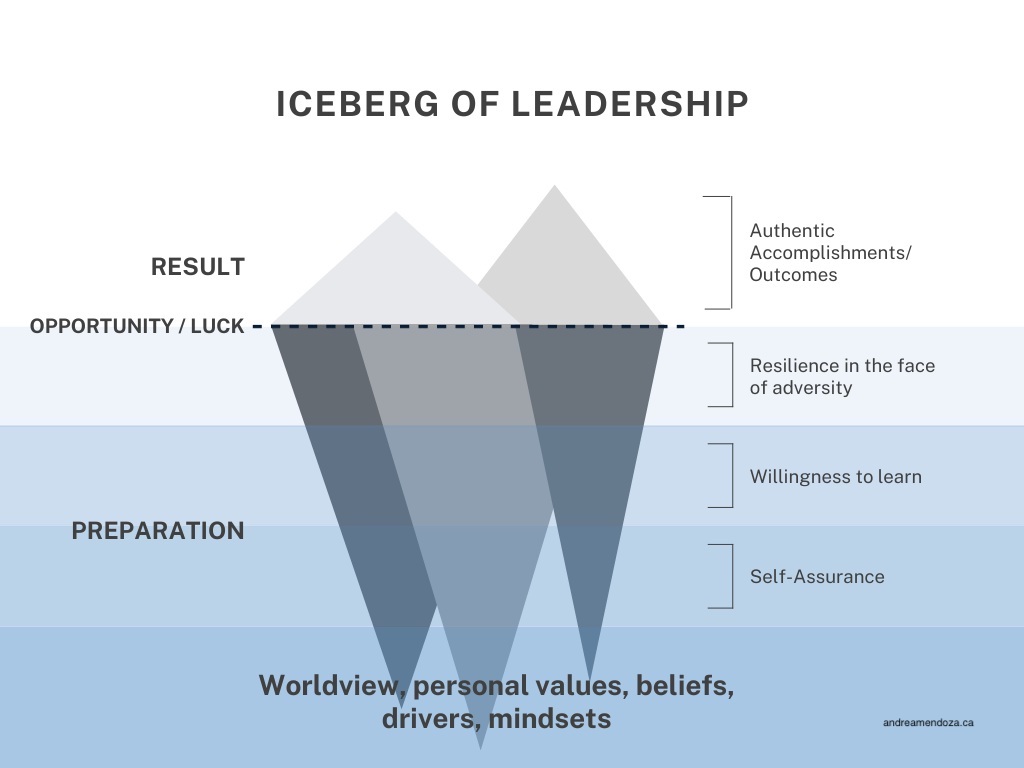
Our ‘Iceberg of Leadership’
Each of our 6 leaders boasted an impressive list of accomplishments, most of which are visible. Although highly individualized, the successes were achieved through an expression of authenticity as each person developed their genuine strengths, followed their passions, and acted with integrity in adverse situations. These accomplishments were initially what prompted us to reach out to these individuals, but through the dissection of each conversation, we exposed a myriad of deeper themes that we believe make up the bulk of the leaders’ stories.
Similar to the composition of a real iceberg (Hall, 1976), we estimate that visible accomplishments (or publicized failures) account for about 10% of a leader’s journey (Wei & Yip, 2008). The remaining 90% sits below the surface, and consists of countless hours of work, reflections on learnings, and mental models – these often invisible aspects form the platform from which a leader can leap from, to take advantage of an opportunity presented. The key events and relationships shared by our leaders further revealed common underlying themes:
- tuning into their authentic self
- demonstrating resilience in the face of adversity
- possessing a willingness to learn
- developing a level of self-assurance
Although deeper beliefs and values were not explicitly explored, certain philosophies and attitudes were apparent through each leaders’ communication, and divergent themes were noted.
We identified ‘opportunity’ as the water line in the iceberg analogy: the leaders’ framed their key events as opportunities, whether they were in the form of a job offer, a chance encounter, a memorable management situation, or a random act of nature. Regardless of their presentation, these occurrences elicited a response that either allowed the leader to leverage their underlying preparation to transcend the water line resulting in an outcome visible to an external viewer.
They also shared experiences where they were not able to seize an opportunity. Their stories led us to hypothesize that at that moment, they might have lacked the skill/capacity/confidence, thus remaining within the invisible ‘development’ zone, thereby extending their preparation to potentially capitalize on future opportunities.
Above The Water Line:
Accomplishment Through Authenticity
Comparing the key events described by our leaders, we noted a vast range of outcomes that we classified as ‘successes’. The interviews revealed that each leader arrived at their successes by identifying their areas of passion (or misalignment), and acting with integrity to stay true to their values. By leaning into their unique combination of strengths, talents, and interests, they cultivated authentic leadership styles. The diversity of their successes stemmed from their diverse expressions of themselves.
In Begin with Trust by (Frei & Morriss, 2020), authenticity is described as a critical aspect of building trust with others and is a foundation of empowered leadership (p.114). “People tend to trust you when they believe they are dealing with the real you” (p. 115), and each of our leaders fostered the real versions of themselves.
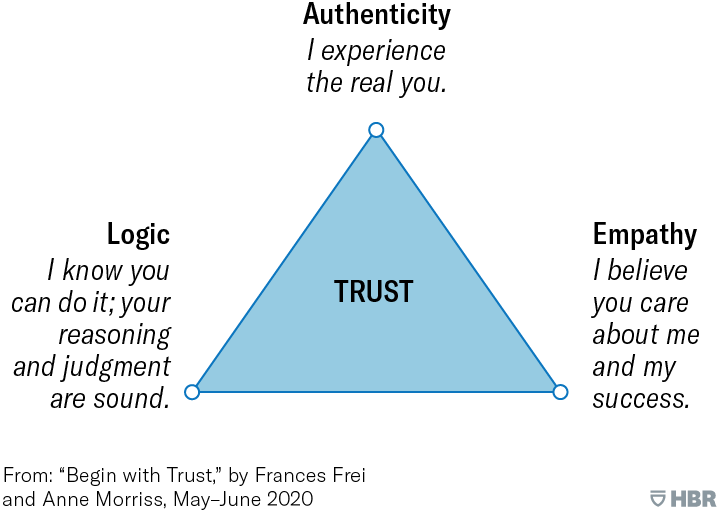
Authenticity sits at the top of the Trust Triangle (p.116), and since it can be observed through external actions and behaviours leading to visible outcomes, this represents the portion of our Iceberg of Leadership that floats above the surface.
The Water Line: Opportunity
In each event, our leaders reached a crossroads – a crux in their story. These defining moments serve as the water line of the iceberg, presenting an opportunity to shift the reputation of a leader. Interestingly, we identified a divergence in how our leaders viewed opportunities.
Some believed their defining moment was self-created or generated through their own planning and effort; others believed that these chance opportunities were a stroke of fate. This distinction in our leaders’ views of water line opportunities as ‘lucky’ or ‘unlucky’ reinforced the variation in their personal experiences, with defining moments sometimes being favourable, and other times, unfavourable.
Hovering Just Below The Surface:
Resilience in the Face of Adversity
“Great leaders are lauded for their successes. But, paradoxically, what makes good leaders great are the trials and tribulations of failure. The lessons learned from confronting fear and uncertainty and experiencing frustration often transform good leaders into great ones. Today, leaders who have endured adversity are most likely to be the ones with the resilience and resolve to succeed.” (Dotlich, 2005)
Each of our leaders experienced many forms of adversity and demonstrated resilience as they worked through these events. At times, the challenges were visible, whether to colleagues or the public. Moreover, their handling of these adversities may also have been public, which led us to place this theme just below the water level of our leadership iceberg. While hardship may be common, our interviewees revealed a shared ability to internally process and apply lessons from these adverse events – important introspection, hidden from view. They highlighted different types of adversity, ranging from work and career to life, personal, and family-related difficulties.
Mid-Depth: Willingness to learn and seeking mentorship
When asked about key relationships, all our interviewees valued the input of other leaders in their development. They recognized their success was not solely achieved through their own volition. Not all had formal mentors, but each conveyed examples of a willingness and desire to learn by seeking advice from those they held in high regard. Our leaders’ mindsets toward continuous learning strongly influenced their responses to opportunities at the ‘waterline’ of the iceberg. Leaders learned more about each event and, subsequently, about themselves; their enthusiasm for improvement bolstered their preparedness, further enabling them to take advantage of future opportunities.
Mentorship and introspection are often done behind the scenes by means of private meetings, reading, and journaling to build the unseen portion of the leadership iceberg. Through a commitment to reflection, humility, and a willingness to examine blind spots, these leaders built their foundation by acquiring external insight.
Going Deeper: Self-Assurance
The final converging theme from our interviews indicated that leaders believe that a sufficient level of self-confidence is necessary to take risks and capitalize on opportunities as they present themselves. Some provided examples of where taking a risk produced a successful outcome that propelled their careers forward. Others provided examples of situations where they didn’t carry the belief in their own capabilities to take action, resulting in a missed opportunity.
At the iceberg’s greatest depth: Values and Worldviews
Personal upbringing, values, and worldviews shape an individual’s perspectives on preparation, luck, and opportunity. These fundamentals drive our decisions, which then manifest as actions and behaviours. Some leaders seemed to lean more towards an internal locus of control and focused on creating their own destinies. Others with a less self-determining mindset viewed situations as lucky or unlucky events. Regardless, they all made mention of the necessity of emotional and technical preparation for any defining event.
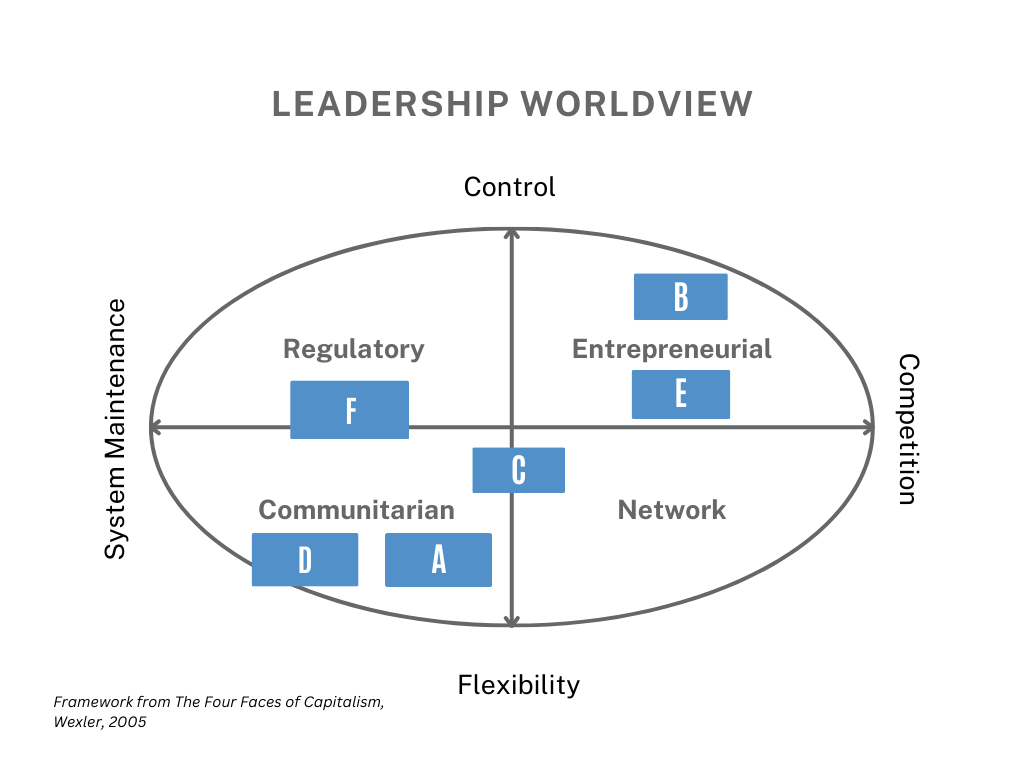
In our short interviews, we didn’t explicitly discuss these underlying values or worldviews of our leaders, nor did we expect them to vulnerably divulge such personal information. However, in comparing their language, demeanors, and approaches to opportunities, we feel it’s reasonable to infer (rather than conclude) that each leader views the world through a different lens.
In Four Faces of Capitalism (Wexler, 2005), Wexler highlights leadership stories that combine the polarities between control and flexibility, and system maintenance and competition. The resulting quadrants offer distinct leadership ‘stories’ of the Bureaucratic, Buccaneer, Knowledge-Driven, and Participative types.
The divergence of leaders’ deeply-rooted values and worldviews shape how the subsequent layers of their individual leadership icebergs are built, ultimately producing an authentic approach to waterline events and resultant visible accomplishments.
Appreciating the Big Picture, Seen and Unseen
At this point in our careers, we understand that most successful individuals have an iceberg of experiences with deep reflections and experiences that lay beneath the surface of their success. The novel thread uncovered through the process of this project was the relationship between opportunity, luck, and the immense amount of behind-the-scenes preparation necessary to enable leaders to identify and capitalize on the events and experiences they have encountered throughout their careers.
Without a strong sense of authentic self, learned resilience through adversity, insight from trusted external sources, and a firm belief in one’s capabilities, leaders may not be able to create or capitalize on opportunities as they arise.
The academic paper we handed in (and/or this blog) may or may not be viewed as an external ‘success’ for our group; however, the wisdom gained from the interviews, solo reflections, thematic analysis, and writing process have contributed to the forming of our own leadership icebergs.
It’s easy to get caught up in visible accomplishments. But as we evolve in our careers to work towards further success, we feel better equipped to examine our individual perspectives of the inevitably intertwined components of Seneca’s formula: opportunity, luck, and preparation.
Full credit of this group paper goes to Team Fox in my SFU EMBA class:
– Ashley Loewen
– Derek Hurley
– Carol Cheong
– Jerome Francis
– Kellen Lee
– Andrea Mendoza
References
Cohen, W. (2019). Drucker’s Top Tips to Successful Leadership. Corporate Learning Network. https://www.corporatelearningnetwork.com/leadership/columns/druckers-top-tips-to-successful-leadership
Dotlich, D. L. (2005). Adversity: What makes a leader the most. Ivey Business Journal, January/February 2005. https://iveybusinessjournal.com/publication/adversity-what-makes-a-leader-the-most/
Frei, F., & Morriss, A. (2020). Begin with trust. Harvard Business Review, 98(3), 112-121
Hall, E. T. (1976) Cultural Iceberg Model: Beyond Culture.
Seneca (2019) The Science of being lucky (P. Hollins) Publishdrive.
Wei, R. R., & Yip, J. (2008). Leadership Wisdom: Discovering the Lessons of Experience. Center for Creative Leadership.
Wexler, M. N. (2005). Leadership in Context: The Four Faces of Capitalism
Join me in the classroom of life!


 Andrea Gets Schooled
Leave a reply to bushesfuca Cancel reply